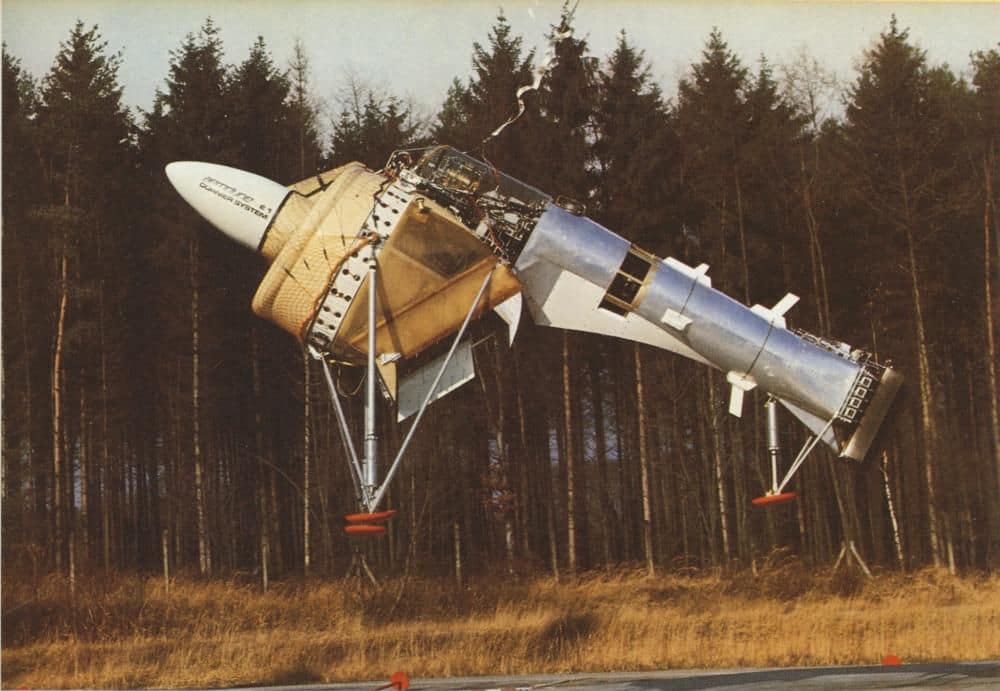
There's a big difference between a propeller with supersonic tip speeds and a supersonic propeller. A supersonic propeller is not strictly impossible, but even after decades of active research remains elusive. You can't simply handwave that you'll use a 3 meter propeller spinning at mach 3 just because it's technically below the limit where it would tear itself apart from centrifugal forces. It doesn't matter what battery energy density you can achieve if the propellers you're using to drive them don't work.
That's not a supersonic propeller, that's a propeller with supersonic tip speeds. A supersonic propeller is a propeller that can work in a supersonic airstream. The XF-84H had a top theoretical speed of Mach 0.9, though in testing it was evaluated to be more like Mach 0.83, and even that's disputed, with another estimate being Mach 0.7. It never achieved these speeds.
The only plane to fly with a propeller at supersonic speeds was the XF-88B, though that was actually a jet aircraft that just had a propeller on the front for testing purposes - the vast majority of the thrust was still coming from the jet engines.
> Coupled with the already considerable noise from the subsonic aspect of the propeller and the T40's dual turbine sections, the aircraft was notorious for inducing severe nausea and headaches among ground crews.[11] In one report, a Republic engineer suffered a seizure after close range exposure to the shock waves emanating from a powered-up XF-84H.[18]
Ducted fans still run into the same issues if the airflow reaching the blades is supersonic. However with a ducted fan you can have the inlet slow the air down to subsonic speeds. In this way ducted fans are used in nearly all supersonic aircraft today. It should be noted though that these turbofans for supersonic use are way smaller than those in use for subsonic aircraft. A 3 meter diameter fan is close to the current limit for such subsonic flight fans, scaling up a supersonic fan that large is still non-trivial.
As for heating up the air and pushing it out, that concept is known as an airbreathing arcjet, which is really just a ramjet. While preventing the electrode from eroding is something of a technical challenge, it's comparatively mild. The main issue here is just power: batteries tend to discharge slowly so to get enough instantaneous power you need a very large number of batteries discharging in parallel, which are very heavy. However if you're just looking to set a speed record and not actually fly any useful distance, this may not be too much of an issue. Personally an arcjet would be my strategy of choice.
Yes that's exactly the principle. You can get up to about mach 3 to mach 4 before stagnation temperature (when you slow down a supersonic flow, it heats up) starts making this approach impractical.
But there's no way of getting around the fact that if you have a 3 meter diameter fan, you have at the very minimum a 7 m^2 cross sectional area that you are sticking into a supersonic airstream, and in reality that inlet is going to be pretty beefy too. That creates a lot of drag that the fan needs to overcome to produce net thrust.
A heat-producing fuel of some sort would make that more efficient. As a bonus, the aircraft would get lighter and lighter as it flew. Imagine the electricity savings!
This comment is ironic because it initially sounds naive, but is probably the most insightful comment.
You could make a supersonic propeller-driven airplane by mounting the propeller(s) in a shroud, using a powerful engine (possibly geared), and slowing down the airstream to subsonic speed in the shroud (the same way a jet engine is designed.)
The result would be a propeller system that outwardly looks like a jet engine, but internally still has propeller(s) on a shaft(s).
The advantage would be better efficiency at low altitudes if a piston engine was used, since piston engines burn about half as much fuel as jet engines.
Nobody will build this unless high-altitude flight is banned, and thus need the efficiency of piston engines.
Rotax uses essentially a geared lawnmower engine in aviation piston applications that is half the weight of a Lycoming or Continental (because of the gearing.) So hey ... there is room for innovation.
You're not going to get a supersonic helicopter (that looks like a conventional helicopter) without retracting the blades for several reasons, starting with the advancing blade being higher speed than the retreating blade, which makes transsonic and supersonic flight with horizontal blades impractical and risky.
Current fast helicopters have stubby wings, so behave like an airplane, which is kind of cheating. To create a supersonic helicopter would mean either ducted fans instead of blades, or an entirely new technology.
Why he hell was the comment that responded to you downvoted? The guy has a background in the area and gave a thoughtful response. I seriously don't know what tha HackerNews mods think sometimes.
A big reason that jet turbines are useful for supersonic aircraft is that their exhaust speed is (pretty much) constant regardless of airspeed; this allows a jet to continue accelerating until the drag force exceeds its thrust. An electric fan could perform similarly if it could provide enough static pressure to achieve supersonic flow through a de Laval nozzle. If that could be done (whether it can is something I'd love to see data on!), the best electric power source would probably have what looks like a regular jet engine intake on the front, a subsonic fan, and a de Laval nozzle in the back like a rocket engine.
Couldn't you just use an electrically-driven turbo compressor to produce a source of hot, high-pressure gasses? Not saying the efficiency or mechanics would play out at scale, but hypothetically you should be able to generate any arbitrary source flow required to feed through this type of nozzle.
In theory? Maybe, but the motor would probably weight more than the whole plane does now. A typical jet engine is producing the equivalent of tens of thousands of horsepower.
Any time someone says they have a design for a prototype that includes aerodynamic aspects, and at the end they say "now scale up by 10" ... there is reason for a strong degree of skepticism.
Interesting point that VTOL actually lets you design your wings only for supersonic flight and avoiding the larger wings (and drag) you’d need for traditional landing and take off.
You might not even need wings. You could just shape the fuselage like a wing. Not sure if that would be the ideal for all applications, though. Maybe the smaller cross-section of small wings and a more narrow fuselage would be better in some situations.
This is like the lifting body aircraft NASA worked on in the 60s[0]. Their downside was high landing speeds which made them dangerous and hard to fly safely, but with VTOL that problem is mostly eliminated.
Edit: That said, I just read the article and his proposal seems completely infeasible to me barring some sort of massive technological breakthrough. I don't think supersonic electric flight is impossible, but I don't think it would look like what he described and I don't think it has any commercial relevance given the current state of technology and its likely future developments.
> The underlying reason that I believe electric aircraft can break the sound barrier is that electric motors can deliver far higher power-to-weight ratios than piston engines, jets, or turbines. The F-4 Phantom is a textbook example of high thrust, being able to (just) achieve a vertical climb. In contrast, for $100 I can buy a racing drone that can accelerate vertically at 10 gs. There are other factors at play but a power-to-weight ratio of 10 screams possibility.
Jet engines have a thrust to weight ratio of about 10.
The power is not so interesting as a lot of the thrust comes from heating the air. Ie the compressor might work at 40 MW and turbine also then of course extracts 40 MW from the airflow.
I'm not sure why one couldn't build an electric supersonic aircraft. It would have very short range. The design presented, could be made more aerodynamic by fairing the motors. Leave a hole in the tip for cooling air. Add a compressor for low speed cooling if needed. Alternatively have liquid cooling.
You could also have a design where the airflow is slowed down in a duct, compressed by a fan and then expanded. The duct would be heavy though. But it might obviate some problems with the free stream propeller.
You WANT wings for supersonic flight (For a normal non missile aircraft). Sure it sucks that its hard to optimize for supersonic flight and subsonic, but you go Supersonic at extremely high altitudes to reduce drag on the plane. This requires a shit ton of power to go forward, without even counting the effort to stay in the air vertically.
As has been pointed out in another post, that doesn't follow.
My body has a thrust to weight ratio of 1, sitting in this chair. A helicopter has a thrust to weight ratio above 1. But neither is capable of supersonic flight. The key is the reaction mass velocity - you can give something a high thrust to weight ratio using very little power by using a large reaction mass and pushing it slowly. For instance, my body is using the whole earth as its reaction mass, and is using zero energy pushing it downwards at zero speed. A jet is much more impressive because it gets that high thrust to weight ratio while using a small reaction mass ejected at a high speed. That is what is required to push an aircraft up to supersonic speeds. A racing drone is closer to a helicopter than a jet aircraft.
However, if the numbers do work out, then I am wondering if it might be possible to fly supersonic much higher than jets, because there is no reduction in engine power. I don't know how high you have to go before your sonic boom no longer reaches the surface, but might there be a possibility of boom-less supersonic flight?
> My body has a thrust to weight ratio of 1, sitting in this chair
No it doesn't. Its 0
> For instance, my body is using the whole earth as its reaction mass, and is using zero energy pushing it downwards at zero speed
That is not how gravity works. There is nothing happening.
> A jet is much more impressive because it gets that high thrust to weight ratio while using a small reaction mass ejected at a high speed. That is what is required to push an aircraft up to supersonic speeds
I wouldn't call it a small reaction mass. A shit ton air is needed to feed the compressor. A jet sacrifices efficiency to get as much mass thrown out the back as fast as possible.
> if it might be possible to fly supersonic much higher than jets, because there is no reduction in engine power.
Why would there be no loss in engine power. If you are using standard propellers, you are limited by air density. If you are using some electric engine to turn a turbine, you have the exact same issue. What magical engine is this electricity powering?
>"I wouldn't call it a small reaction mass. A shit ton air is needed to feed the compressor. A jet sacrifices efficiency to get as much mass thrown out the back as fast as possible."
It's the other way round - a Jet gains efficiency the more air mass it can 'process', because larger mass means you need to throw it out at a lower velocity to get the same impulse from it. If you compare formulas for momentum and kinetic energy, which are, respectively:
p = m * v and e = 0.5 * m * v ^2
You will see that energy needed for higher velocities grows quadratically, while the momentum you get from it grows linearly.
basically that's why we have Turbofan engines with high bypass rations, to increase efficiency of passenger Jets
I know how a turbofans/jets work. My comment had nothing to do with the comparison with turbofans, and only that large amounts of air is being moved.
> It's the other way round - a Jet gains efficiency the more air mass it can 'process', because larger mass means you need to throw it out at a lower velocity to get the same impulse from it.
How is it the other way around, I explicitly said a Turbojet sacrifices efficiency to increase exit velocity.
Firstly, if you are gonna poke holes in other people's arguments, don't get defensive when someone corrects you, especially when you make such precise and well qualified claims as "Shitton of air". Neither were also not spesific about Turbofan vs Turbojet.
Regardles of which one it is, the point of the previous poster stull stands. His point of comparison is how reaction mass compares to the weight of the vehicles.
All jets move less air, by mass, than helicopters do, when measured as a fraction of the vehicle's mass.
> Why would there be no loss in engine power. If you are using standard propellers, you are limited by air density. If you are using some electric engine to turn a turbine, you have the exact same issue. What magical engine is this electricity powering?
Parent is assuming that combustion engines run out of oxygen to burn before the propeller runs out of atmosphere to push against.
Yeah, big difference between a plane that has to carry a person, weapons, and enough fuel to be useful and a toy which is basically 4 motors, a tiny battery and a few grams of plastic. You take just the F-4's engine and 2 minutes worth of fuel and that thing will accelerate very quickly.
I have no numbers for the Rutherford engine on the Electron rocket. Amusing idea would be take a page from that and design a ram jet with an electric turbine to get it going.
IIRC it was one of the only fighters that could accelerate straight up at the time. Now there are others, including the F-16, which originally could not, but the more recent variants have considerably more power and now it can.
Yes, that's very silly. It's entirely a question of scale, which is handwaved. You can also buy a gloplug fossil-fueled model airplane which can also accelerate vertically at ridiculous speeds.
I'm surprised that no one is discussing electrohydrodynamic engines for this application, for example as used by https://en.wikipedia.org/wiki/MIT_EAD_Airframe_Version_2. These don't have the same limitations as rotors do with vectoring relative to high speed gas flow. Most of the ones which have been built are small, but that is not an intrinsic limitation; mainly its the battery weight that is the limiting factor.
Of course, the whole idea of electric field is depending on the battery breakthrough, but assuming you have that and want to go supersonic, I'd figure you would go EHD.
For reasons I can't entirely recall, there are pretty serious limitations on the thrust these can generate. I believe it has something to do with the air becoming "saturated" with ions. The limit on the density of charged particles limits how much mass you have to push on. The aircraft in your link has a top speed of 17km/h.
Heating the air with microwaves or an electric arc could work, since it would just be replacing burning fuel with another heat source. It would still require moving parts though (unless it's only used as a ramjet), since a jet engine has to compress the air before heating it.
You don't strictly need one. There are designs that rely on exhaust pulse resonance for pressure. There are designs that use various kinds of mechanical valves.
It looks like (propane fuel) tesla valve pulse jets have been built, but I'm not seeing anything flight capable.
You need something to make sure the hot air only comes out one end of the engine, otherwise you get net zero thrust. In a normal jet the compressor takes care of this.
Supersonic electric flight could be a propeled glider that goes stright up, hides the propellers and engines bhind some aerodynamic covers and glides at supersonic speed, then repeats the procedure as many times as needed.
Another idea is to make a turbo-jet engine heated by electricity instead of fuel.
I guess it could depend on your definition of "glide", but I doubt that anything gliding at supersonic speed would have a very good glide ratio. Thus, it wouldn't really cover much ground even thought it might travel quite a bit vertically.
If we consider the reason one wants to travel at supersonic speeds, we might arrive at something involving the value of a human's time. Given that, slow but ultra efficient, luxurious (and internet-connected - "workable") travel might be something. Then gliding, floating, etc. with ample space and creature comforts could be the focus.
Electric jet engine powered by a heat pump. I wonder if anyone has looked into that?
You could collect a lot of heat from the airflow over the body. Meaning there would be a lot of air with some level of heat that’s constantly being replaced.
There is a company called Sion Power that claims to have 500 Wh/kg batteries [0]. "With supply dates beginning in mid-2021 for UAV markets. Broader distribution for the Licerion-HE is scheduled for early 2022."
I believe lithium iron phosphate tends to be around 120-150 Wh/kg, pretty decent regular lithium ion tends to be around 150, fairly recent Tesla battery packs are a bit over 200.
(These are types of batteries that have been around for years that you can easily buy as a normal person for a reasonable cost. There's probably a lot of fancy/new battery technology that is somewhat better but either not mass-produced yet or otherwise prohibitively expensive, or trades off some other desirable quality like safety or durability to get more capacity.)
>Is it possible to have a liquid hydrogen and liquid oxygen airplane?
Yeah, you just usually don't carry oxygen with you when you can get it free from the atmosphere, since it subtracts directly from your payload capacity.
you don't need wings. For high-speed long distance the most efficient trajectory is ballistic - thus passenger variant Starship carrying 100-500 passengers at $2-5M/launch (thus $5-20K/ticket) will, i think, be the next transcontinental mode of transportation (less than 1 hour SF-Melbourne).
tldr; they become "practical" with a battery specific energy of around 1500 Wh/kg. However, if you just want to do a demonstration, they are practical now (as this post suggests).
>The underlying reason that I believe electric aircraft can break the sound barrier is that electric motors can deliver far higher power-to-weight ratios than piston engines, jets, or turbines.
That's a completely worthless figure of merit (I assume he means thrust to weight; because electric helicopters have abysmal power to weight ratio -shit like this matters) and no reason to believe in this nonsense. By the same reasoning, one could build a piston engined supersonic aircraft because there are piston engined helicopters. Another thing that has a high thrust to weight ratio; those water rockets I used to play with as a kid.[0] Pretty sure you can't go supersonic with those either unless you fire them out of a howitzer.
Electric airplanes are a terrible idea without battery technology comparable to hydrocarbon power to weight ratios. Even then, they're a terrible idea unless the motivating technology is lighter than a jet engine and tanks for reasons that should be obvious to anyone with high school physics educations.
> By the same reasoning, one could build a piston engined supersonic aircraft...
Now that's a thought provoking engineering problem!
Assume a supersonic propeller is required.
Using the Thunderscreech as a baseline, which admittedly didn't quit go supersonic, but it gets us close.
Its powerplant produced nearly 6,000 horsepower.
That is certainly doable with a piston engine, top fuel dragster engines produce roughly 10,000 horsepower. For about ten seconds.
If this plane burned nitromethane, it wouldn't even need much atmospheric oxygen, nitromethane required roughly one tenth the amount of oxygen per mass of jet fuel. Of course, this means it has to carry a lot more fuel
Burt Rutan was interested in going after it with the Pond Racer, but they didn't get past their test program before one of the engines threw a rod and ended the project. Apparently the math said it'd have been capable of just barely going supersonic when level.